
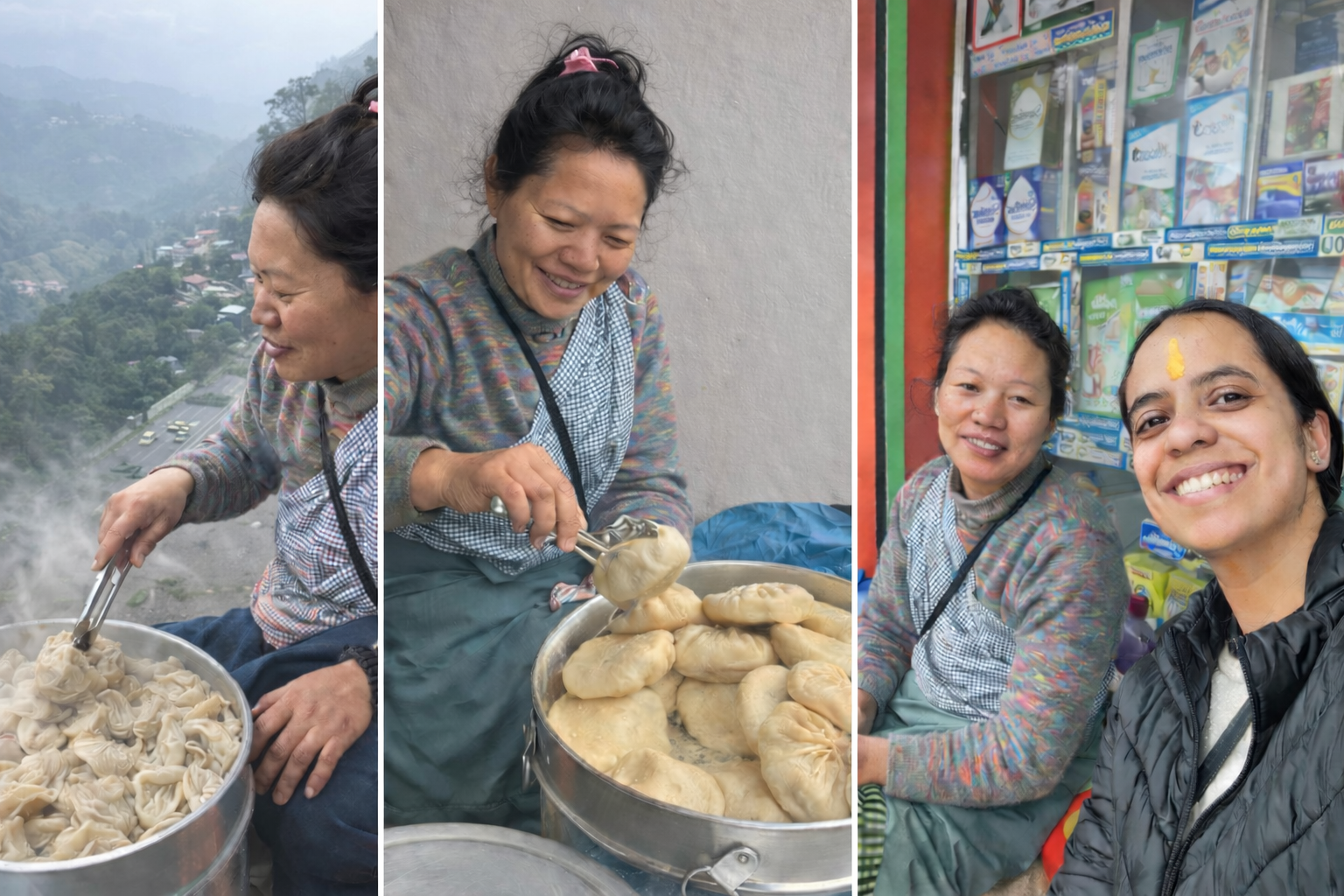
When I used to visit a temple in the Laban area of Shillong, I would see her almost every day. She sat calmly on a stool outside a chemist shop along the main road, her large steamer placed neatly beside her. As I walked back after my visit, our eyes would meet and she would smile at me. It became a quiet routine. We never spoke, but the exchange of smiles felt familiar.
One day, I stopped at the chemist shop to buy sanitary napkins. I was not feeling like myself that afternoon. My mood was low, and I felt the kind of heaviness that comes without a clear reason. I was rather feeling very unsettled, the kind of emotional fluctuation that quietly drains you. So, instead of rushing back home, I lingered there for a moment. I had seen her so many times, always sitting there with patience and warmth, and that day I felt like observing and talking to her.
I stood by her stall to buy momos, and before I could say or greet her, she gently pulled out a small stool and offered it to me. That simple gesture felt unexpectedly comforting. I sat down, and we began to talk.
Her name is Yater Taki. She lives alone. Every morning, she wakes up at 5:30 a.m. to prepare her momos at home. She kneads the dough, chops onions, crushes garlic, and mixes a little cabbage for the filling. By 2 p.m., she sets up her place outside the chemist shop and remains there until all the momos are sold.
I asked her where does she live and she told me it’s nearby at a distance of 5 km. Then I asked her that how she manages to carry everything back home. So, she smiled and said, “I walk.” As if walking back alone with empty vessels and a tired body was the most natural thing in the world. She brings her utensils, her steamer, and stools and other utensils with her on foot. There was no trace of self-pity in her voice. It was simply her routine.
Then I asked her if she has kids. She shook her head gently. “I don’t want tensions in my life,” she said. Then she smiled and added she chose not to marry. Well in the Northeast, where arranged marriages are uncommon and relationships are based on personal choice, and then when she said she never found someone she truly liked, so it was understandable. As we know, quantity and quality are different things. So maybe she simply never found someone who felt right. Maybe she chose peace over compromise. There was no regret in her voice but only calm certainty.
Then understanding that she lives by herself, I was concerned and I asked whether she ever feels unsafe walking home alone in the evening. So, she told me her sister lives nearby, and she calls her while returning sometimes if it gets late or if she feels unsafe. There was something deeply moving about that, the independence supported by quiet sisterhood. There was reassurance in the way she said it like she has created her own sense of safety and support.
Then I asked her something that had been on my mind. For a Khasi woman, selling only vegetarian food is unusual, especially in a place where chicken and pork are so loved. She explained that many of her regular customers are Marwadi families and she keeps her food purely vegetarian so they can eat comfortably. Her choice reflected thoughtfulness and awareness of the people she serves, that she wanted to particularly cater to., though she is a non-vegetarian herself.
Her momos are remarkably thin. Her momos are unlike any others. They are so thin that they sometimes break when you lift them. She makes both big ones and tiny ones. The filling is nothing extraordinary but just onion, garlic, and a little cabbage. Maybe it’s because they are so delicate, so light, so easy to pop into your mouth and ofcourse its texture which includes the fragile wrapper that almost melts before you realize it.
There is something about women like Yater Taki that humbles you. She does not speak of struggle dramatically. She does not complain. She simply wakes up, works, walks, adapts, and returns home.
As I sat there on that small stool she offered me, I realized that the comfort I was looking for that afternoon did not come from any spiritual sermon or therapy or philosophical learnings about life. It came from a quiet woman who wakes up before sunrise, works with steady hands, walks home alone, and smiles at strangers every day.
From that spot outside the chemist shop, I could see the steep market road stretching downward, busy yet distant. Beyond it, the soft outline of the mountains stood calmly against the sky. The air carried a slight chill, and right beside me, the steam from her momos made me feel warm while also watching Yater arrange the dumplings and trying to keep the charcoal lit. I felt a bit grateful to be in a clean environment with humble and nice people, that I often take for granted because I am so busy in my own problems.
So i just chose to sit there for a while, breathing, watching, and slowly feeling lighter. Nothing extraordinary was happening but I was feeling better and relaxed. In that ordinary roadside setup, between the steep lanes of Shillong and the rising mountain view, I felt held by the simplicity of it all, like whatever it takes to keep going.
Yater Taki’s life is not loud, but it is deeply dignified. It is built on routine, self-respect, and gentle strength that she follows just for ‘herself’. That day, when I was feeling low, her simple kindness and steady presence reminded me that resilience does not always announce itself. Sometimes, it sits outside a chemist shop, steaming momos, and smiling back at you.
P.S. She also offered me free extra momos during our conversation.
Leave a Reply