
I have never considered myself deeply religious, as I have never naturally felt an inclination toward it. I have also struggled to connect with many traditional texts whose claims cannot be verified in today’s world. Because of this, the rituals, the formal prayers, the elaborate offerings, and the structured devotion never formed the center of my spiritual life. It has never felt to me that divinity waits for our flowers, our sweets, or our carefully arranged ceremonies. Infact, I find it difficult to believe that Shiva is seated somewhere expecting prasadam or measuring devotion through repetition of external acts. If he represents the vastness of consciousness itself, then how can be be limited by ritual? Though I never question the great acts and worships of devotees and gurus because I know that everyone has their own reasons, beliefs and experiences with God just like I am sharing mine here, however the traditional forms of worship have never drawn me strongly.
Yet the presence of Shiva has felt magnetic to me, and to be honest, especially recently, I experienced this pull couple of years back also but I was conditional to my state of mind and when that purpose was fulfilled temporarily, I gave up on it. The attraction has not arise from stories or puranas. It arises from his persona and from what he represents within the human psyche. Shiva stands as a symbol of inner stillness, radical simplicity, and the dissolution of ego. His personality speaks less about worship and more about awakening.
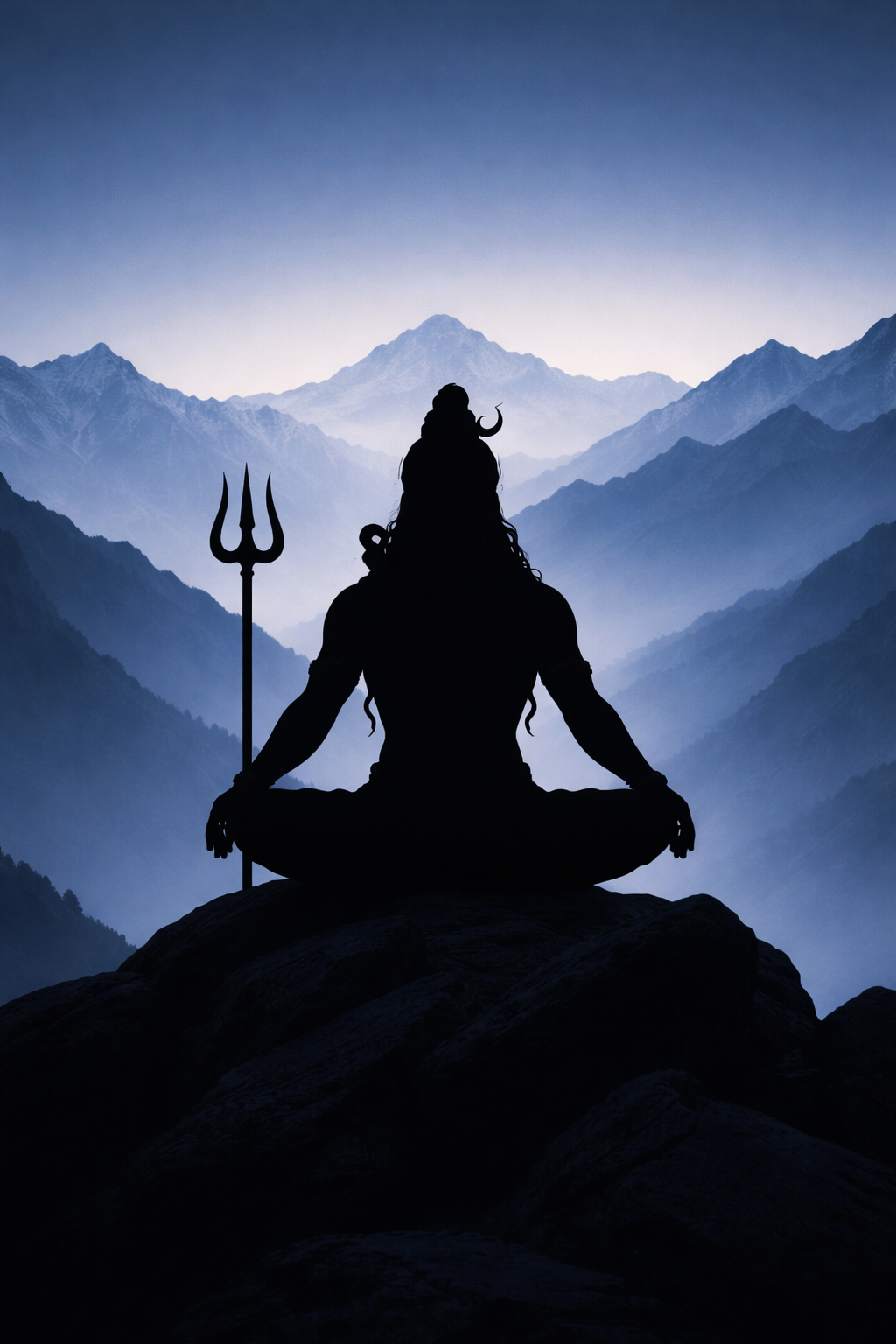
When I look at the meditative posture associated with Shiva, I do not merely see a deity seated in the Himalayas. I see the archetype of yogic absorption. The upright spine reflects alignment between body, breath, and awareness. In yogic philosophy, this alignment prepares one for dhyana, the uninterrupted flow of attention toward a single point. His closed eyes suggest pratyahara, the withdrawal of the senses from external distractions. The world continues to move, yet consciousness turns inward.
Over time, I began to understand that this posture is not symbolic alone. It is instructional too as it invites stillness and asks for the courage to sit quietly and observe the turbulence within. Shiva’s silence reflects the state described in yogic texts as samadhi, where the sense of separate identity dissolves. In that dissolution, what remains is just awareness.
Saadhna, as reflected in Shiva’s life, is not performance. It is discipline directed inward. It is that tapas, the inner fire that burns impurities of the mind. When I reflect on this, I realize that true saadhna is not about renouncing the world externally but it is about renouncing restlessness internally. The Himalayas where Shiva meditates symbolize stability and elevation of consciousness. The snow that surrounds him represents clarity. In that vast stillness, the thoughts slow down as the dentity begins to loosen. Maybe it is not about loosing identity but it is gradual process of letting go on its own.
Then coming to His Third Eye, which carries deep philosophical meaningas it is described as the eye of destruction, yet its destruction is not violence. It is the burning away of illusion. In yogic understanding, this corresponds to awakening of the higher perception, the ability to see beyond surface reality. This is when the ignorance dissolves and ego cannot survive. The opening of the third eye represents insight that reduces attachments to ashes.
The ash covering his body reminds constantly of the impermanence. As everything material returns to dust. In contemplating this, there is a quiet humility. The possessions, the status, the recognition, all sens to lose intensity when viewed against this impermanence. Even then the simplicity becomes natural rather than forced. Similarly, Shiva’s acceptance of simple offerings, leaves, water, modest food, reflects the freedom from excess. Spiritual depth does not demand luxury. Maybe, it requires sincerity and awareness.
The river Ganga flowing from his matted hair holds another subtle teaching. The uncontrolled descent of divine energy could have destroyed the earth, yet through Shiva it becomes gentle and life-giving. Philosophically, this mirrors the channeling of inner energy through disciplined awareness. In yogic practice, awakening the energy without grounding can create imbalance. Shiva’s steadiness represents the capacity to hold this intensity without being overwhelmed.
Another powerful image is Shiva as Nataraja, the cosmic dancer. In that form, he dances within a circle of fire, symbolizing creation and dissolution happening simultaneously. One foot crushes ignorance, while another lifts in liberation. The dance teaches that destruction and renewal are not opposites. They are movements of the same rhythm. Within each ending lies a beginning. Within each loss lies transformation. Observing this symbolism reshapes my understanding of change. Instead of resisting cycles, I begin to witness them and understand that how change is the only constant.
Shiva’s acceptance extends to all beings. He welcomes gods, demons, animals, and outcasts alike. This inclusiveness reflects consciousness that sees beyond labels. In yogic philosophy, the highest awareness transcends dualities of good and bad, pure and impure. So, when the judgment dissolves, the heart becomes expansive. That expansiveness feels close to what I understand as the zero state.
The idea that sins are forgiven in his worship can also be understood philosophically. Forgiveness is not a transaction. It is release. When one turns inward sincerely, the guilt and the shame lose their grip. In deep meditation, one gets an opportunity to see the actions clearly without the distortion of ego. It is like the awareness leading to the path of purifity. This zero state is not moral superiority. It is freedom from identification with past conditioning.
Over time, my relationship with Shiva is becoming less about devotion in the conventional sense and more about aspiring toward this zero state. This Zero is not emptiness in a negative sense. It is the ground before identity forms. It is the consciousness without the agitation. It is the presence without the craving. In yogic language, it is shunya, the fertile emptiness from which awareness expands.
In the moments of stillness, when thoughts briefly pause, I sense a glimpse of that state. There is no need to prove, acquire, or defend. There is simply being. These moments are small, yet creating a wave of peace. They remind me that the journey toward zero is not about the dramatic renunciation but it is about the gradual dissolution of unnecessary noise.
Drawing inspiration from Shiva is meant to simplify one’s life, to accept the impermanence, to cultivate the disciplined awareness, and to embrace all the aspects of existence without resistance. It is to understand that spiritual growth is not just external worship but more about inner alignment.
The zero state is not far away in some distant mountain. It is a silent possibility within. Shiva, to me, is the reminder of that possibility.
I am aware that all of this is easier said than done. As the mind reacts quickly. There are moments when I feel a strong urge to answer back, to defend myself, to express hurt, to respond immediately to what disturbs me. The pull of reaction can feel intense. Yet I have also experienced brief moments of emptiness while remembering Shiva, moments where there was no impulse to retaliate, no compulsion to prove, only stillness. Even if those moments lasted only seconds, they showed me that such a state exists.
Because I have touched that silence, I know it is real. I know the zero state is not imagination. It is accessible. I may not remain there constantly, but I can practice. I can attempt to pause before reacting. I can attempt to respond from awareness instead of impulse. I can attempt to embody, in small ways, the holiness of that emptiness.
Perhaps I do not need to constantly remind myself of this consciousness. Perhaps I simply need to practice becoming quieter within. If I can return, again and again, to that state of no reaction, even imperfectly, then maybe I am walking the path that Shiva silently represents.
In the Vijnana Bhairava Tantra, Bhairava is revealed in the pause between breaths, in the quiet interval between two thoughts where mental movement comes to rest. The Shiva Sutras open with the statement “Chaitanyam Atma,” affirming that consciousness itself is the Self, and they describe the dissolving of vikalpa, or conceptual thought, as the unveiling of one’s true nature. In this understanding, Shunya becomes the state of nirvikalpa, awareness free from fragmentation and inner division. It is fullness without fixation, presence without the constant commentary of ego. The teaching of spanda, the subtle pulsation of consciousness, suggests that beneath every reaction there exists a prior stillness from which awareness arises. When the “I” that defends, explains, and asserts itself grows quiet, what remains is a clear and luminous ground of being. That ground is what I have tried explaining as the zero state, a simple resting in consciousness itself, where life continues to unfold yet the center remains undisturbed.
Leave a Reply